
Business Setup in Dubai for Indians 2026: Complete Guide
Everything Indian entrepreneurs need to set up in Dubai in 2026: free zone vs mainland, costs, visas, banking, India's ODI and LRS rules, tax residency and the step-by-step process.
Quick answer: can Indians set up a business in Dubai?
- Yes. Indian nationals can own 100% of a company in UAE free zones and, for most activities, on the Dubai mainland.
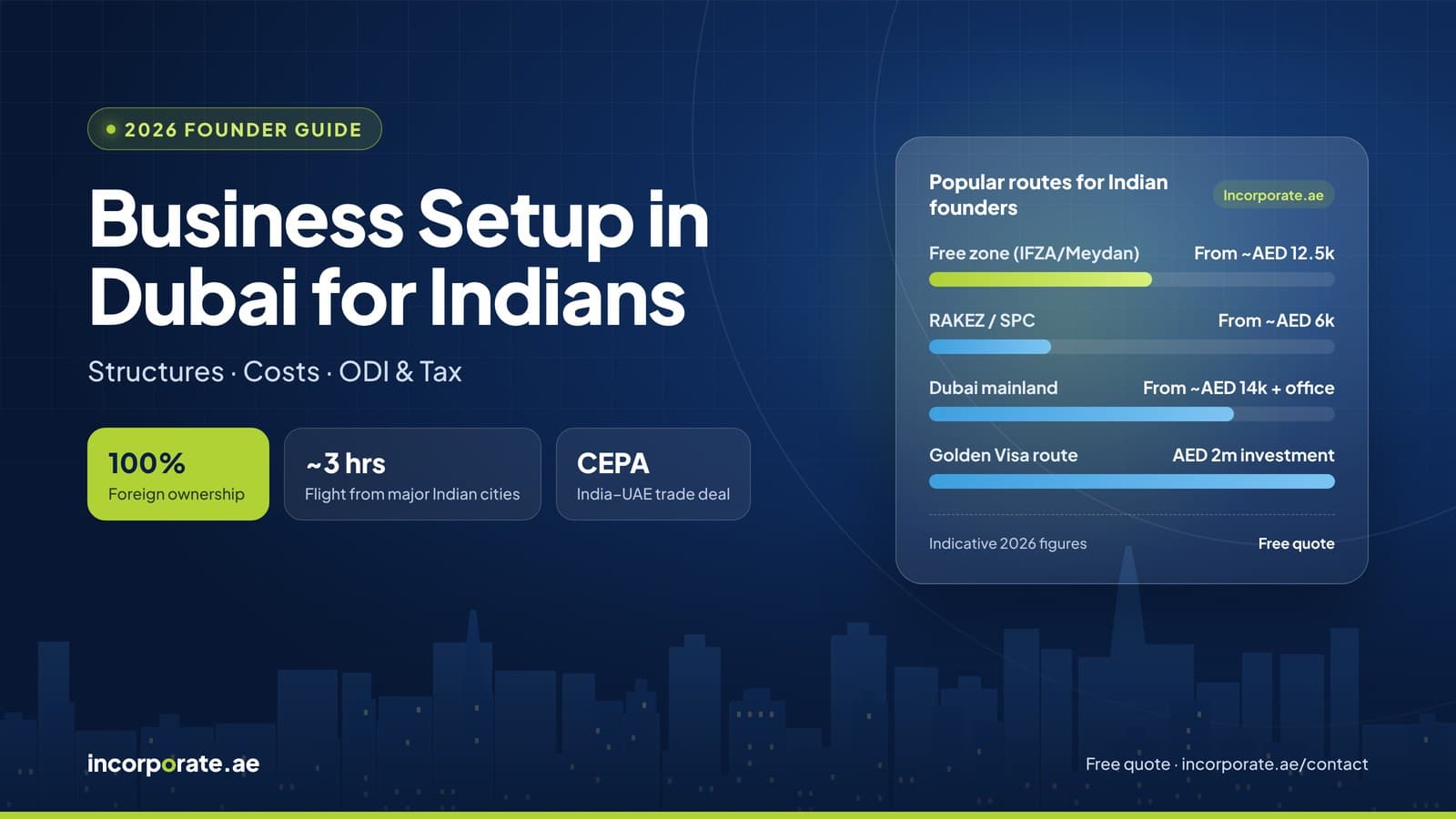
- Free zone setups start from about AED 6,000 – 13,000; a Dubai mainland company starts from about AED 14,000 in government fees plus office rent.
- If you are an Indian tax resident, investing in a UAE company must follow India's Overseas Direct Investment (ODI) rules and the Liberalised Remittance Scheme (LRS) limits.
- Your company can sponsor your UAE residence visa and your family, and long-term investors can qualify for the Golden Visa.
Indians are the largest expatriate community in the UAE and one of the biggest groups of company owners in Dubai. Short flights, a familiar business culture, strong trade links and the India–UAE Comprehensive Economic Partnership Agreement (CEPA) make Dubai a natural base for Indian entrepreneurs who want to sell to the Gulf, Africa and the wider world. This guide explains business setup in Dubai for Indians in 2026: the right structure, real costs, visas, banking, and the Indian rules you must follow if you are still a tax resident in India.
Why Indian Entrepreneurs Choose Dubai
Advantages
- 100% ownership in free zones and most mainland activities
- No personal income tax in the UAE
- Corporate tax of 0% on profit up to AED 375,000, 9% above
- CEPA trade benefits between India and the UAE
- Large Indian community, suppliers and customers
- Easy travel to India for family and business
Things to plan for
- India's ODI and LRS rules if you remain an Indian tax resident
- Tax residency and the 'place of effective management' of your company
- Bank due diligence on funds coming from India
- Choosing the right jurisdiction for your customers
- Visa and health insurance for family members
Free Zone, Mainland or Offshore?
| Structure | Best for | Typical starting cost |
|---|---|---|
| Free zone company | Consultants, IT, e-commerce, trading with overseas clients | From ~AED 6,000 (RAKEZ) to ~AED 13,000 (IFZA, Meydan) |
| Dubai mainland company | Selling to UAE customers, shops, restaurants, government contracts | From ~AED 14,000 in government fees plus office |
| Offshore company | Holding assets and investments, no UAE trading or visas | From ~AED 10,000 – 15,000 |
Most Indian IT consultants, software companies and e-commerce founders start in a free zone such as IFZA, Meydan or RAKEZ. Traders who will sell in UAE markets, restaurant owners and retailers usually need the Dubai mainland. Our jurisdiction wizard recommends the right option in a few minutes.
Popular Businesses for Indian Founders
- IT services and software, often serving clients in India, the GCC, Europe and the US.
- General trading and import–export, including foodstuff, textiles, electronics and building materials, often using CEPA benefits.
- Restaurants and cloud kitchens, from regional Indian cuisine to fusion brands; see our cloud kitchen guide.
- Gold and jewellery, a long-standing link between Dubai and India.
- Consultancy, accounting and recruitment services for Gulf companies.
India's Rules: ODI and LRS
If you are a resident of India under Indian foreign exchange law and you invest in a UAE company, you must follow India's Overseas Investment rules under FEMA. In simple terms:
- Individuals can invest abroad through the Liberalised Remittance Scheme (LRS), which allows remittances of up to USD 250,000 per financial year for permitted purposes, including overseas direct investment in an operating company.
- Indian companies investing in a UAE subsidiary follow the ODI framework, with limits linked to their net worth and reporting through an authorised dealer bank.
- Investments must usually be in a company doing real business, and structures that route money back into India through layers of companies face restrictions.
- Your Indian bank will ask for documents and file reports on your behalf, and annual reporting may be required.
Do not fund your UAE company informally or through a friend's account. Banks in both countries check source of funds, and non-compliance with FEMA can bring penalties. Speak to a chartered accountant in India before remitting capital.
If you have moved to the UAE and become a non-resident under Indian law, these restrictions generally no longer apply in the same way, but your income-tax residency in India still matters.
Tax Residency and Double Taxation
India and the UAE have a Double Taxation Avoidance Agreement (DTAA), so the same income should not be taxed twice. Two points matter most for Indian founders:
- Your personal residency: under Indian tax law, your residency depends mainly on the days you spend in India. If you remain an Indian tax resident, your worldwide income, including dividends from your UAE company, may be taxable in India. A UAE Tax Residency Certificate can help when claiming treaty benefits.
- Place of Effective Management (POEM): if your UAE company is effectively managed from India, India may treat it as an Indian tax resident. Hold board meetings, sign contracts and take key decisions in the UAE to keep management genuinely there.
In the UAE, your company registers for corporate tax; read our UAE corporate tax guide for the rates, Small Business Relief and free zone rules.
Visas for You and Your Family
Your company can sponsor your investor or partner visa, usually valid for two years. Once you have residency you can sponsor your spouse and children, and in many cases your parents, subject to income and accommodation rules. Investors with at least AED 2 million in qualifying investments, and successful entrepreneurs, can apply for the 5 or 10-year Golden Visa; see our Golden Visa guide for business owners.
Opening a Bank Account
UAE banks welcome Indian-owned companies, but they check carefully where funds come from. Prepare your passport, visa and Emirates ID, trade licence and company documents, a short business profile, expected transactions and countries, and evidence of the source of your capital, such as Indian bank statements and LRS or ODI documents. Digital banks are often faster for new companies, while traditional banks offer wider services. Our bank account assistance team prepares the file and introduces you to suitable banks.
Step-by-Step: Setting Up From India
- 1Plan the structure and Indian complianceWeek 1
Choose free zone or mainland, and speak to your Indian CA about ODI, LRS and tax residency.
- 2Choose activities and reserve the nameWeek 1
Select activities that match how you will earn money, and reserve your company name.
- 3Submit documents remotelyWeek 1 – 2
Send passport copies, photos and, if needed, address proof. Most free zones allow remote signing.
- 4Receive the licenceWeek 1 – 3
Free zone licences often arrive within days; mainland licences within one to three weeks.
- 5Remit capital through proper channelsWeek 2 – 4
Transfer funds via your authorised dealer bank under LRS or ODI, keeping all paperwork.
- 6Visa, Emirates ID and bank accountWeek 3 – 6
Travel to the UAE for the medical test and biometrics, then open your corporate account.
Documents Checklist
- Passport copy (valid at least six months) and photo
- Indian address proof (such as Aadhaar or a utility bill) if requested
- PAN card for Indian bank and ODI paperwork
- Business plan for some activities and banks
- For Indian company shareholders: certificate of incorporation, board resolution, MOA and AOA, attested by the UAE embassy and Ministry of Foreign Affairs
If an Indian company will own the UAE company, start the attestation of its documents early. Attestation through the UAE embassy and MOFA is often the slowest part of the process.
Worked Example: An IT Consultant Moving From Bengaluru
Rahul runs IT consulting projects for clients in the Gulf and Europe and plans to move to Dubai with his wife and daughter. He sets up a free zone company with an IT consultancy activity and one investor visa. Before sending money, his chartered accountant in India confirms the remittance under LRS and files the required forms through his bank. The licence is issued within a week, and he travels to Dubai for his medical test and Emirates ID. Once his visa is stamped, he sponsors his wife and daughter. Because he will now spend most of the year in Dubai and manage the company from there, he expects to become a non-resident for Indian tax purposes, and he obtains a UAE Tax Residency Certificate after his first year.
Common Mistakes to Avoid
- Choosing the cheapest free zone without checking whether it suits your customers.
- Remitting capital without ODI or LRS paperwork.
- Running the UAE company entirely from India, creating a POEM risk.
- Ignoring Indian tax on dividends while still an Indian tax resident.
- Underestimating bank due diligence on funds from India.
Using CEPA as an Indian Trader
The India–UAE Comprehensive Economic Partnership Agreement, in force since 2022, reduced or removed customs duties on a wide range of goods traded between the two countries. For Indian founders running trading companies in the UAE, this can lower the cost of importing goods from India and make Indian products more competitive in Gulf markets. To benefit, goods usually need a valid certificate of origin showing they meet the agreement's origin rules. Check the duty rate for your product codes and make sure your suppliers can provide the right documents before you price your goods.
Trading companies that import into the UAE also need a customs code and, depending on the products, approvals from bodies such as Dubai Municipality for food or the relevant ministry for regulated goods.
After You Move: NRI Status and Indian Accounts
When you relocate to Dubai and become a non-resident under Indian law, you should tell your Indian banks and convert resident savings accounts into NRO or NRE accounts as required. NRE accounts are used for income earned abroad and are generally repatriable, while NRO accounts hold income earned in India, such as rent or interest. Update your PAN details and inform your investment platforms of your new status. Keep records of the days you spend in India each year, because they decide your Indian tax residency, and file Indian tax returns where you still have taxable Indian income. Getting this right early avoids problems with banks and tax authorities later.
Frequently Asked Questions
Can an Indian citizen own 100% of a company in Dubai?
Yes. Indian nationals can own 100% of free zone companies and, for most activities, 100% of Dubai mainland companies.
What is the cheapest way for an Indian to start a business in Dubai?
Low-cost free zones such as RAKEZ, SPC or Ajman start from about AED 6,000 without a visa. Dubai free zones such as IFZA and Meydan start from about AED 12,500 – 13,000.
Do I need to follow ODI rules to invest in a UAE company?
If you are a resident of India under FEMA, yes. Individuals usually invest under the Liberalised Remittance Scheme, and Indian companies under the ODI framework, through an authorised dealer bank.
Is there a tax treaty between India and the UAE?
Yes. The India–UAE Double Taxation Avoidance Agreement helps prevent the same income from being taxed in both countries.
Will I pay tax in India on my Dubai income?
It depends on your tax residency. If you remain an Indian tax resident, your worldwide income may be taxable in India. Non-residents are generally taxed in India only on Indian income.
Can I sponsor my family on my business visa?
Yes. Once you hold a UAE residence visa, you can sponsor your spouse and children, and often your parents, subject to income and accommodation rules.
Can I set up a Dubai company while living in India?
Yes. Most free zones allow remote setup. You need to travel to the UAE for the visa medical test and Emirates ID biometrics.
Which free zone is best for Indian IT companies?
IFZA, Meydan, Dubai Silicon Oasis and Dubai Internet City are popular. The best choice depends on your budget, visas and whether you need a Dubai address.
Start your Dubai business from India
One team for your company, visas, bank account and UAE tax registration.
Fees are indicative for 2026 and based on published authority price lists and typical government charges at the time of writing. They change, so confirm current figures with the authority or our team before you apply.
Written by
Incorporate.ae advisory team
Company formation consultants in Dubai who have helped 1,500+ businesses set up across the UAE’s free zones and mainland.
Share this article
Keep reading
All insights → Nov 17, 2026RAKEZ License Cost 2026: Packages, Visa Fees and Facilities
 Nov 16, 2026Dubai Mainland Company Setup Cost 2026: Full Fee Breakdown
 Nov 15, 2026How to Start a Cloud Kitchen in Dubai 2026: Licence, Costs and Growth Plan
 Nov 14, 2026Trade Licence Amendment in UAE: Add Activities, Change Name, Partners and More