
Best Banks for Business Accounts in UAE 2026: Fees, Minimum Balance and Approval Tips
A practical comparison of the best UAE banks for business accounts in 2026: digital and traditional options, minimum balances, monthly fees, documents, approval times and how to avoid rejection.
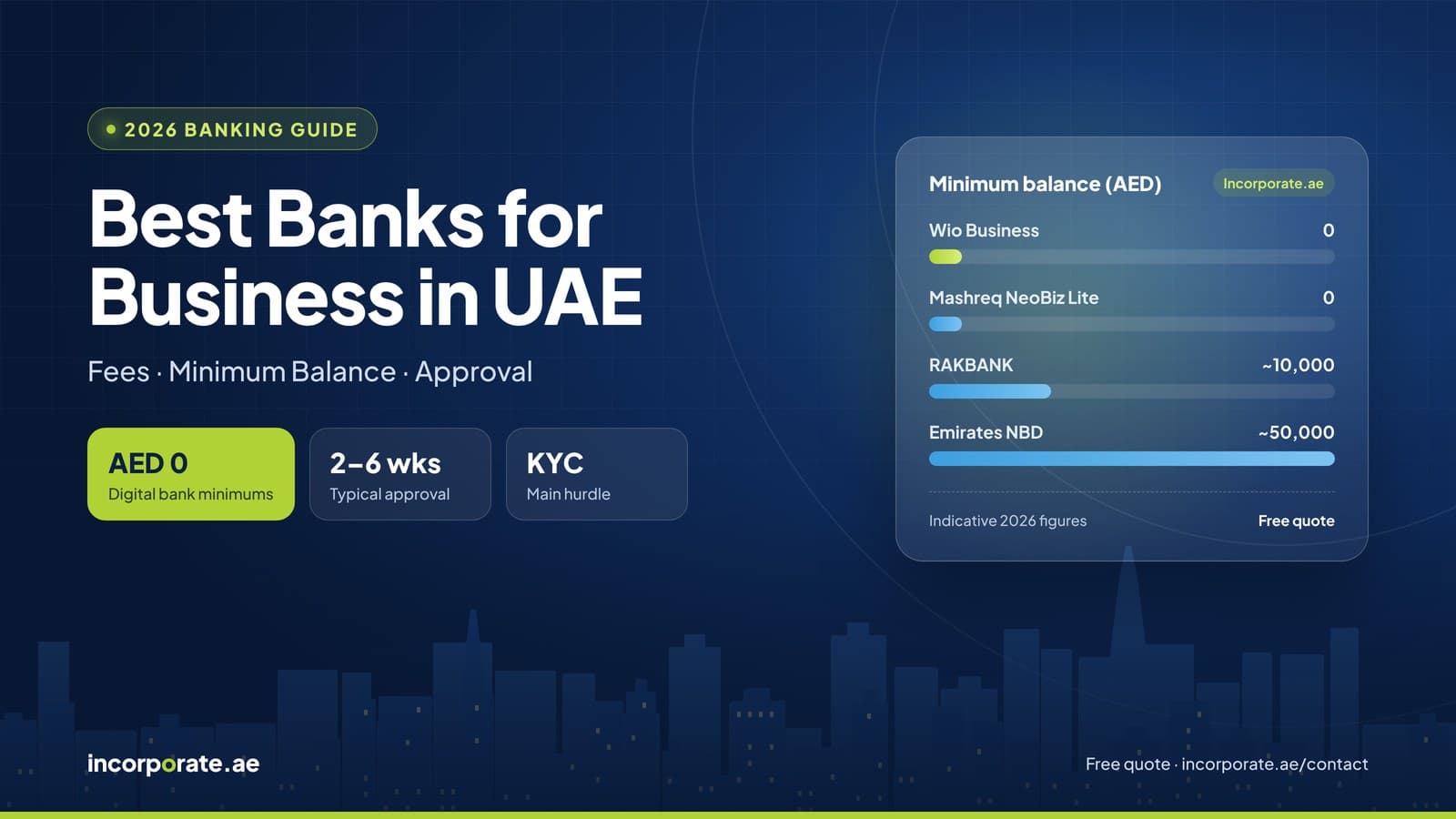
Quick answer: which bank is best for a UAE business account?
- For new startups and freelancers, digital banks such as Wio Business and Mashreq NeoBiz are usually best: no minimum balance and fast online opening.
- For growing SMEs, RAKBANK offers a good balance of low minimums (around AED 10,000) and full branch services.
- For larger companies with trade finance needs, Emirates NBD, FAB, ADCB and HSBC offer the widest services, with higher minimum balances.
- Approval depends far more on KYC (who you are, what you do and who pays you) than on which bank you pick.
A business bank account is often the hardest step of UAE company setup. The licence can arrive in days, but banks take weeks to approve an account, and many founders are rejected on their first attempt. Choosing the right bank for your business type, and preparing the right documents, makes a large difference. This guide compares the best banks for business accounts in the UAE in 2026, with minimum balances, fees and practical tips for approval.
UAE Business Banks Compared
| Bank | Minimum balance (AED) | Monthly fee (AED) | Best for |
|---|---|---|---|
| Wio Business | 0 | ~99 – 249 depending on plan | Startups, freelancers, online businesses |
| Mashreq NeoBiz (Lite) | 0 | ~200 if conditions not met | Startups wanting a traditional bank brand |
| Mashreq NeoBiz (Prime) | ~50,000 | Waived when balance kept | Growing SMEs |
| RAKBANK | ~10,000 | ~99, often waived | Small and medium businesses |
| Emirates NBD | ~50,000 | ~250 below minimum | Established companies, trade |
| ADCB | Assessed individually | Varies | SMEs and corporates |
| ADIB | Assessed individually | Varies | Islamic banking |
| FAB | Assessed individually | Varies | Larger companies, trade finance |
| HSBC | Assessed individually | Varies | International groups |
Indicative 2026 terms. Banks change pricing and eligibility often, so confirm the current offer before applying.
Digital Banks vs Traditional Banks
Digital banks
- No or low minimum balance
- Online application and fast IBAN
- Lower monthly fees
- Good apps and card controls
- Limited cash deposits and trade finance
Traditional banks
- Higher minimum balances
- Branch services and relationship managers
- Cheques, cash handling and trade finance
- Better for large transfers and loans
- Slower onboarding with more paperwork
Many founders start with a digital bank to begin trading quickly, then add a traditional bank once revenue and trade finance needs grow. Holding two accounts also protects you if one bank freezes or reviews your account.
Documents Banks Ask For
- Trade licence, memorandum of association and share certificate
- Passports, visas and Emirates IDs of shareholders and signatories
- Proof of address for owners (utility bill or tenancy contract)
- A short business plan or company profile
- Evidence of business activity: contracts, invoices, website, supplier and client details
- Expected monthly turnover and main countries you will deal with
- Source of funds and source of wealth for owners
- Personal bank statements, often for six months
- For corporate shareholders: attested group documents and ownership structure
Step-by-Step: Opening a Business Account
- 1Prepare your KYC packWeek 1
Collect licence documents, IDs, a company profile and proof of activity before you apply.
- 2Choose the right bankWeek 1
Match the bank to your activity, turnover and the countries you work with.
- 3Apply online or in branchWeek 1 – 2
Digital banks take applications in the app; traditional banks assign a relationship manager.
- 4Compliance reviewWeek 2 – 5
The bank checks owners, activity, funds and expected transactions, and may ask follow-up questions.
- 5Account approval and IBANWeek 2 – 6
Once approved, you receive your IBAN, online banking and cards.
- 6Fund and start tradingAfter approval
Deposit the initial balance and keep activity consistent with what you declared.
Describe your business in simple, specific terms: who your clients are, what you sell, which countries pay you and roughly how much. Vague answers are the most common reason for delays.
Why Business Accounts Get Rejected
- Unclear activity: the bank cannot understand what the business does.
- High-risk sectors: crypto, general trading with sanctioned countries or cash-heavy businesses face more checks.
- No UAE link: owners without residency or local presence are harder to onboard.
- Weak source of funds: no proof of where the starting capital came from.
- Mismatch: licence activities do not match the business described.
Once your account is open, keep transactions in line with what you told the bank. Sudden large transfers from unexpected countries can trigger reviews or freezes.
Which Bank for Which Business?
| Business type | Good starting options |
|---|---|
| Freelancer or consultant | Wio, Mashreq NeoBiz Lite |
| E-commerce brand | Wio, Mashreq NeoBiz, plus a payment gateway |
| Restaurant or café | RAKBANK, Emirates NBD (cash and POS needs) |
| Trading company | RAKBANK, Emirates NBD, FAB (trade finance) |
| Holding company | Traditional bank with relationship manager |
| Islamic finance preference | ADIB, Dubai Islamic Bank |
If you are opening a food business, our guides on starting a restaurant and opening a café cover POS and payment needs.
Free Zone vs Mainland Companies
Banks open accounts for both, but they look more closely at free zone companies with flexi-desk offices because physical presence is lower. A mainland company with an office, staff and local clients is usually easier to onboard. Our free zone vs mainland guide explains the trade-offs, and offshore companies face the strictest checks of all.
Fees to Watch Beyond the Minimum Balance
- Monthly maintenance fees if your balance falls below the minimum
- International transfer fees and FX margins
- Cheque book and card fees
- Payroll (WPS) processing fees
- Cash deposit and withdrawal fees
- Account closure fees in the first year
Worked Example: A Consultant and a Trading Company
Rahul opens a consulting company in a free zone and applies to Wio with his licence, a one-page company profile and two signed client contracts. His IBAN is issued within three days, with no minimum balance and a low monthly plan. Meanwhile, Layla's mainland trading company imports goods from China and Turkey. She applies to RAKBANK with supplier invoices, a client list and six months of personal statements. Approval takes four weeks, but she gets a relationship manager, cheque book and access to trade finance. Each chose the bank that fitted their activity, not the one with the biggest brand.
How Long Does It Take?
Digital banks can issue an IBAN in as little as 48 hours for straightforward applications. Traditional banks usually take two to six weeks, and longer for complex structures, corporate shareholders or high-risk activities. Opening the account is also a step in your wider setup timeline; see our business setup cost guide for the full picture.
Keeping Your Account Healthy
Banks review accounts regularly. Respond quickly to KYC update requests, renew your trade licence on time, keep your Emirates ID valid, and update the bank when shareholders or signatories change. Expired documents are a common reason for accounts being restricted.
What Banks Look for in Your Business Plan
Banks do not need a long investor-style business plan. They want a clear, short explanation of your business that their compliance team can understand quickly. A good bank profile is two to four pages and answers simple questions: what the company does, who the owners are, where clients and suppliers are based, how money will come in and go out, and what monthly turnover you expect. Include your website, social media pages and any signed contracts or invoices. Consistency is important: your licence activities, profile and expected transactions should all tell the same story.
| Section | What to include |
|---|---|
| Company overview | Licence, jurisdiction, activities and owners |
| Products or services | What you sell and how you deliver it |
| Clients and suppliers | Main names or types, and the countries they are in |
| Expected transactions | Monthly turnover, typical payment sizes and currencies |
| Source of funds | Where the starting capital comes from, with evidence |
Payment Gateways and Multi-Currency Accounts
Online businesses often need more than a bank account. Payment gateways let you accept card payments on your website or app, and most require a UAE business account to settle funds. Several banks and payment providers also offer multi-currency accounts in USD, EUR and GBP, which can cut foreign exchange costs if you invoice clients abroad. Compare FX margins, settlement times and chargeback rules, not just monthly fees. If you sell mainly to international clients, a multi-currency setup can save more than the difference in account fees.
Banking for Non-Resident Owners
Owners who do not live in the UAE can still open a business account, but it is harder. Banks prefer at least one shareholder or signatory with a UAE residence visa, and some require owners to visit a branch in person. Non-residents should expect more questions about source of funds, the reason for using a UAE company and where clients are based. Getting an investor visa through your company is often the simplest way to make banking easier; our UAE investor visa guide explains how.
The Central Bank of the UAE sets anti-money laundering and KYC rules that apply to all banks, so the documents requested are broadly similar everywhere. What differs is each bank's appetite for particular activities, countries and company sizes.
Questions to Ask Before You Choose a Bank
- What is the minimum average balance, and what is the fee if we fall below it?
- How much are local and international transfers, and what FX margin applies?
- Can we process payroll through the Wage Protection System?
- Are cheque books, debit cards and corporate credit cards available, and at what cost?
- How many users and approval levels does online banking allow?
- Is trade finance, such as letters of credit, available for our size?
- How long does onboarding take for our activity and structure?
- Will we have a named relationship manager?
Asking these questions at the start helps you compare banks on total cost and service, not just the headline minimum balance. A bank that looks cheap can cost more once transfers, FX and card fees are added.
Switching Banks Later
If your first bank no longer fits, you can open a second account and move your payments gradually. Update clients with your new IBAN, move payroll and direct debits, and keep the old account open until all incoming payments have switched. Closing an account too early can bounce client payments and cause compliance questions at the new bank.
Frequently Asked Questions
Which is the best bank for a business account in the UAE?
It depends on your business. Digital banks such as Wio and Mashreq NeoBiz suit startups, RAKBANK suits SMEs, and Emirates NBD, FAB, ADCB and HSBC suit larger companies.
Which UAE bank has no minimum balance for business accounts?
Wio Business and Mashreq NeoBiz Lite offer business accounts with no minimum balance, with monthly plan fees instead.
How long does it take to open a business bank account in Dubai?
Digital banks can issue an IBAN in about 48 hours; traditional banks usually take two to six weeks.
Can a free zone company open a UAE bank account?
Yes. Free zone companies can open accounts with UAE banks, though banks may ask for more evidence of real activity.
Do I need a UAE visa to open a business account?
Most banks strongly prefer at least one shareholder or signatory with a UAE residence visa. Non-resident owners face more checks.
Why was my business account rejected?
Common reasons include unclear activity, high-risk sectors, weak source of funds, mismatched licence activities or no UAE presence.
Can I open a business account online?
Yes. Digital banks and some traditional banks allow fully or mostly online applications.
Should I open more than one business account?
Many businesses keep two accounts: a digital account for day-to-day use and a traditional bank for larger transactions and trade finance.
Open your UAE business account with less hassle
We prepare your KYC file, choose the right bank and follow up until your IBAN is ready.
Fees are indicative for 2026 and based on published authority price lists and typical government charges at the time of writing. They change, so confirm current figures with the authority or our team before you apply.
Written by
Incorporate.ae advisory team
Company formation consultants in Dubai who have helped 1,500+ businesses set up across the UAE’s free zones and mainland.
Share this article
Keep reading
All insights →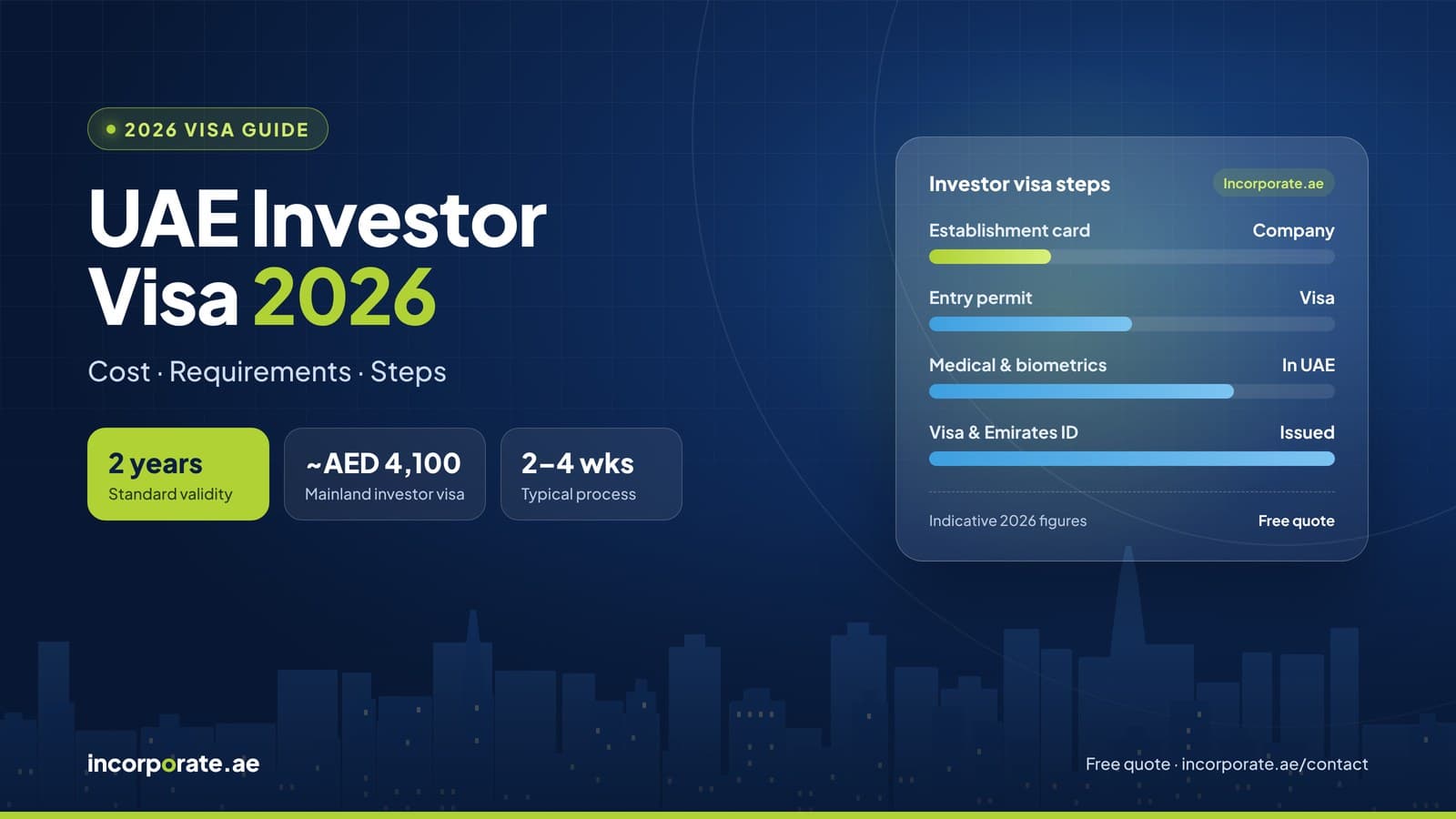 Nov 25, 2026UAE Investor Visa 2026: Cost, Requirements and Step-by-Step Process
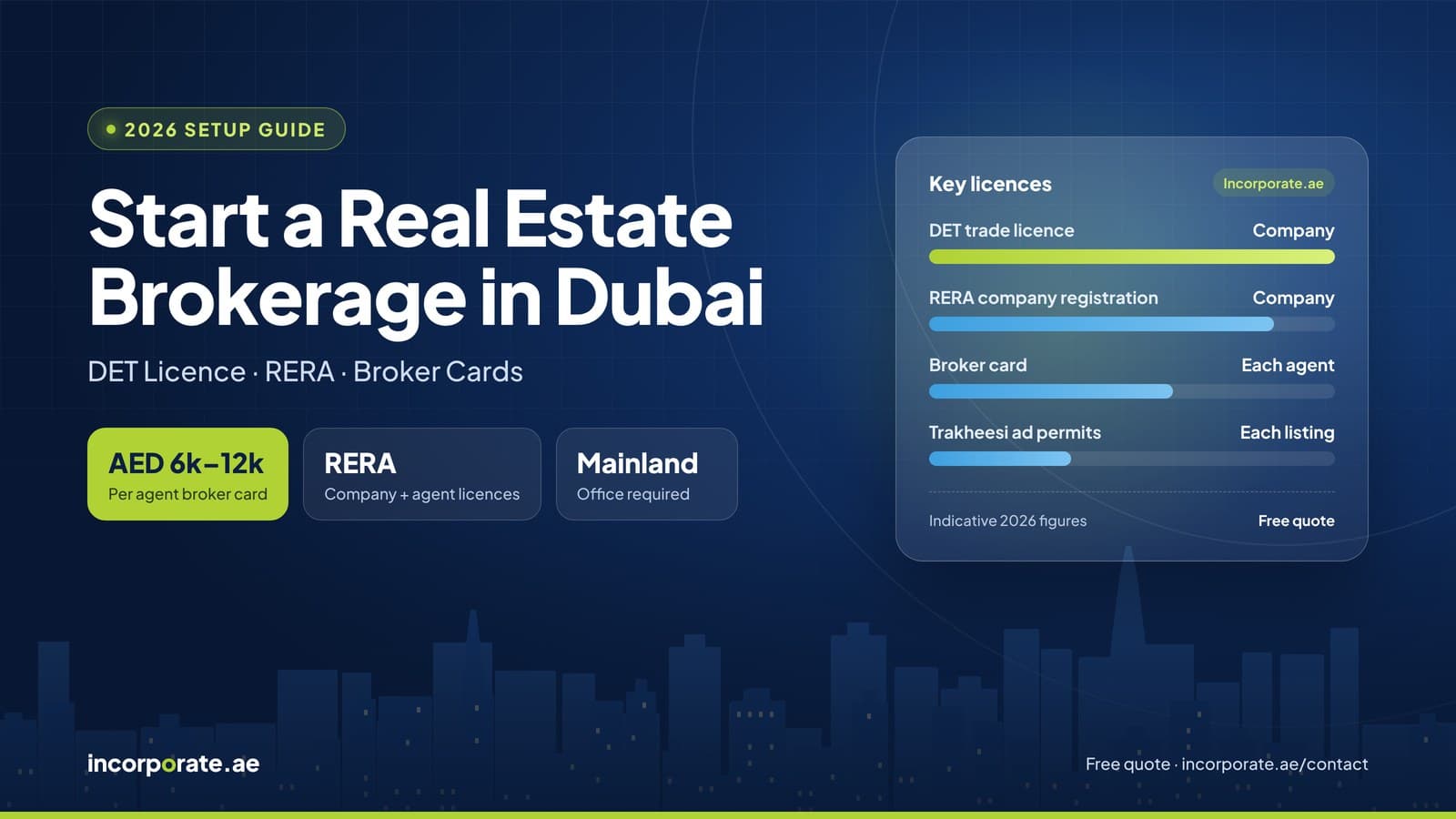 Nov 24, 2026How to Start a Real Estate Brokerage in Dubai 2026: RERA Licence, Costs and Steps
 Nov 23, 2026Corporate Tax Registration in UAE 2026: Step-by-Step on EmaraTax
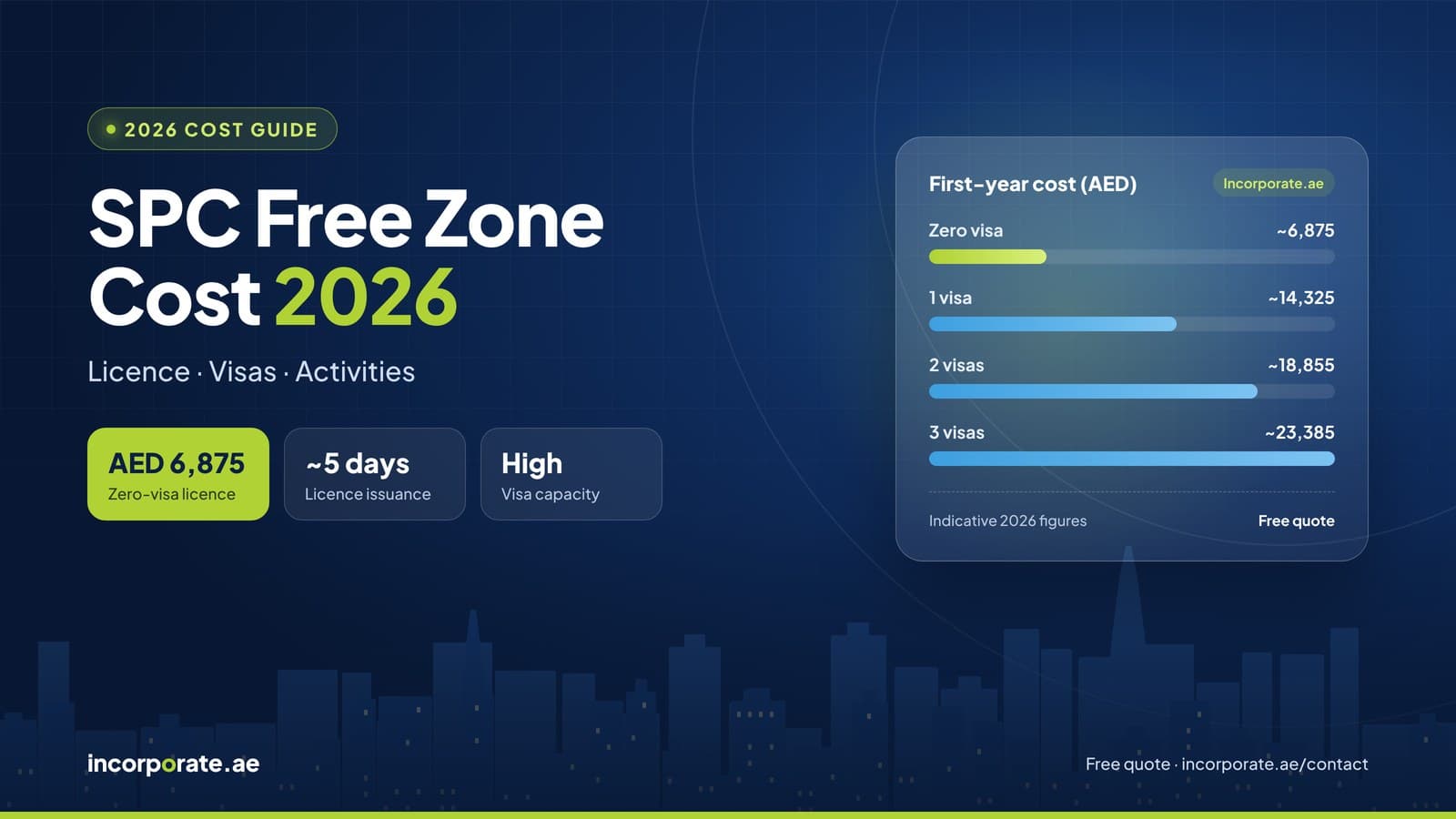 Nov 22, 2026SPC Free Zone Cost 2026: Sharjah Publishing City Licence and Visa Fees