
Free Zone vs Mainland vs Offshore 2026: Which UAE Company Is Right for You?
A clear decision guide to the three UAE company types in 2026: free zone, mainland and offshore. Compare trading rights, visas, offices, tax, cost and banking, with examples and a checklist.
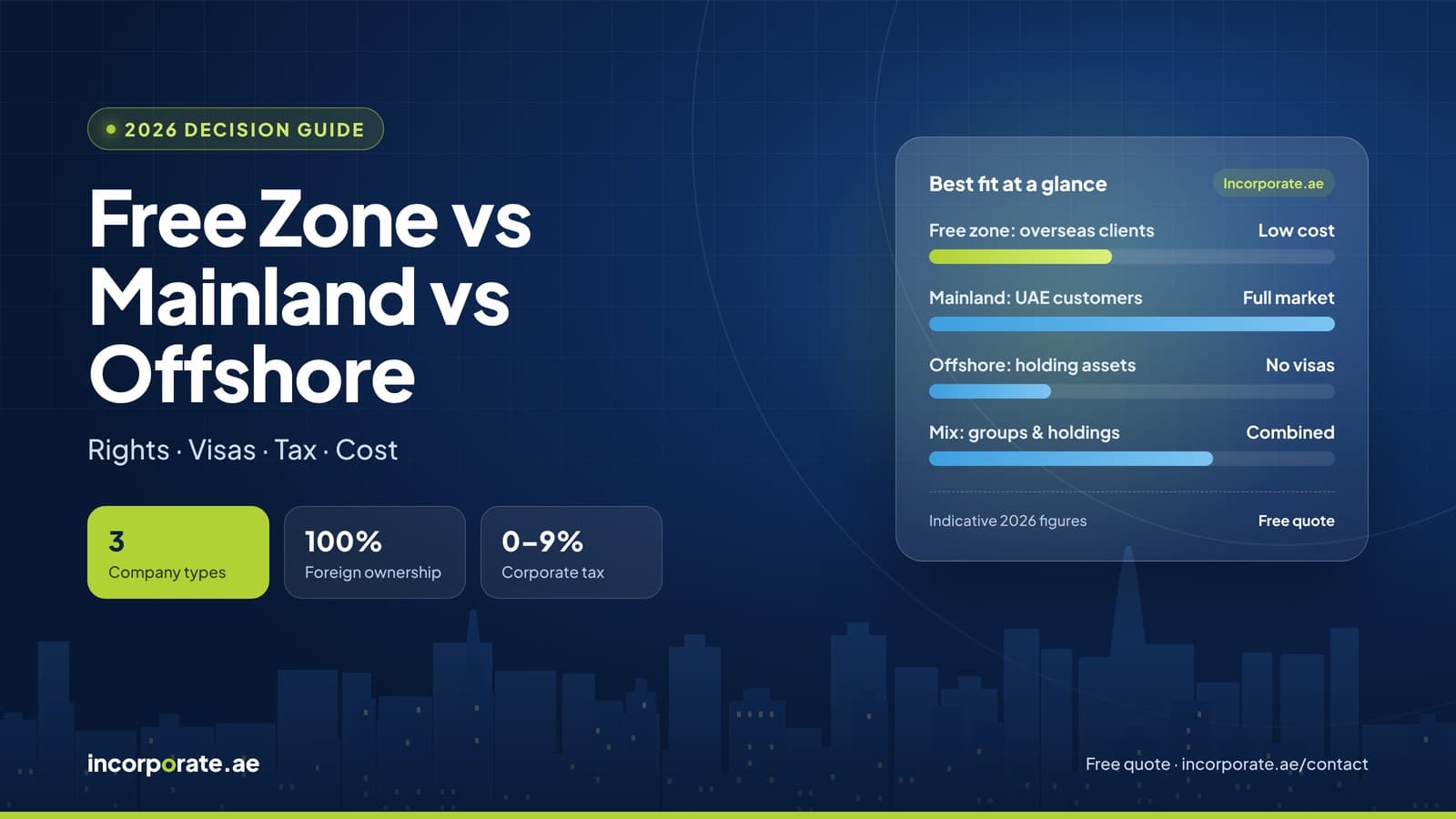
Quick answer: free zone, mainland or offshore?
- Choose a mainland company if you will sell directly to customers in the UAE, need a shop or restaurant, or want government contracts.
- Choose a free zone company if you mainly serve overseas clients or other free zone companies, want a low-cost setup and may qualify for 0% tax on qualifying income.
- Choose an offshore company to hold assets, shares, intellectual property or property, with no UAE trading, no office and no visas.
- Many groups combine them: for example a free zone operating company owned by an offshore or free zone holding company.
Choosing the right type of company is the most important decision in your UAE setup. It decides who you can sell to, how many visas you can get, whether you need an office, how you are taxed and what you pay every year. Get it right and your company grows smoothly; get it wrong and you may face amendments, a second company or a costly restructure later. This guide compares free zone vs mainland vs offshore in 2026 in plain language and gives you a simple checklist to decide.
The Three Company Types in One Table
| Factor | Mainland | Free zone | Offshore |
|---|---|---|---|
| Licensing authority | Department of Economy and Tourism (Dubai) or the emirate's economic department | The free zone authority, such as IFZA, Meydan, DMCC or RAKEZ | An offshore registry, such as RAK ICC or JAFZA Offshore |
| Ownership | 100% foreign for most activities | 100% foreign | 100% foreign |
| Trade in the UAE market | Yes, anywhere | Inside the zone and abroad; mainland sales need a distributor, branch or permit | No UAE trading |
| Residence visas | Yes, based on office size | Yes, based on package or office | No |
| Office required | Yes, with Ejari | Flexi-desk is often enough | Registered agent address only |
| Corporate tax | 0% up to AED 375k profit, 9% above | 0% on qualifying income if a Qualifying Free Zone Person; otherwise standard rates | Standard rules apply; usually holding income |
| Typical starting cost | ~AED 14,000 + office | ~AED 6,000 – 13,000 | ~AED 10,000 – 15,000 |
| Best for | Retail, restaurants, contracting, local services | Consultants, IT, e-commerce, trading abroad | Holding companies, assets, property, IP |
Mainland Companies
A mainland company is licensed by the emirate's economic department, such as DET in Dubai. It can trade anywhere in the UAE, open shops and branches across the country, and work directly with government entities. Most activities now allow 100% foreign ownership. The trade-off is that you need a physical office with Ejari, and your visa quota depends on that office. Read our Dubai mainland cost guide for every fee.
Mainland strengths
- Unrestricted access to UAE customers
- Shops, restaurants, showrooms and branches
- Government and semi-government contracts
- Visa quota grows with office space
Mainland trade-offs
- Office with Ejari required
- Higher annual cost than most free zones
- Standard corporate tax rates apply
- Some regulated activities need extra approvals
Free Zone Companies
The UAE has dozens of free zones, each with its own authority and rules. Free zone companies enjoy 100% ownership, simple setup, flexi-desk options and, if they qualify, 0% corporate tax on qualifying income. They are ideal for businesses whose customers are overseas or in other free zones. Selling directly to the UAE mainland usually requires a mainland distributor, a branch or a specific permit, and mainland income can affect the 0% rate. Compare costs in our guides to RAKEZ, IFZA, Meydan and DMCC, or the side-by-side business setup cost guide.
Free zone strengths
- Low setup and renewal costs
- Fast, often fully remote setup
- Flexi-desk instead of a full office
- Possible 0% tax on qualifying income
Free zone trade-offs
- Limited direct trading with the UAE mainland
- Activities limited to the zone's list
- Qualifying Free Zone Person rules are strict
- Visa quota tied to package or space
Offshore Companies
An offshore company, from registries such as RAK ICC or JAFZA Offshore, is a legal entity for holding and international activity. It cannot trade in the UAE, cannot sponsor visas and does not lease office space. It is used to hold shares in other companies, own intellectual property, hold investments and, in approved freehold areas, own property in Dubai and other emirates. Offshore companies need a registered agent and must still meet UAE rules on beneficial ownership, economic substance where relevant and corporate tax registration.
Offshore strengths
- Simple, low-cost holding vehicle
- Confidential and flexible for international groups
- Can own property in approved areas
- Useful for succession and asset planning
Offshore limits
- No trading inside the UAE
- No residence visas
- Banks apply strict due diligence
- Not suitable as an operating company
"Offshore" in the UAE does not mean secret or tax-free in every case. Offshore companies must keep beneficial ownership records, may need to register for corporate tax and must follow anti-money laundering rules.
Tax Differences
All three types fall under UAE corporate tax. Mainland companies pay 0% on taxable profit up to AED 375,000 and 9% above. Free zone companies can pay 0% on qualifying income if they meet every Qualifying Free Zone Person condition, but pay standard rates on non-qualifying income above the de minimis limit. Holding companies can often use the participation exemption on dividends and gains from qualifying shareholdings. For the details, read our corporate tax guide for SMEs.
Decision Checklist
| Question | If yes, consider |
|---|---|
| Will most of your customers be in the UAE? | Mainland |
| Do you need a shop, restaurant, clinic or showroom? | Mainland |
| Do you want government contracts? | Mainland |
| Are most of your clients overseas or in free zones? | Free zone |
| Do you want the lowest annual cost with a visa? | Free zone (for example RAKEZ) |
| Do you only need to hold shares, IP or property? | Offshore or free zone holding company |
| Do you need residence visas? | Mainland or free zone, not offshore |
You can also use our free jurisdiction wizard and the startup viability scorecard to test your plan.
Combining Structures
Growing businesses often use more than one entity. Common combinations include:
- Free zone operating company + mainland branch: serve international clients from the free zone and UAE customers through the branch.
- Holding company + operating companies: an offshore or free zone holding company owns several operating companies, which separates risk and simplifies future sales.
- Mainland company + free zone trading arm: keep local retail on the mainland and export trading in a free zone.
Splitting a business across entities only to stay below tax thresholds or to shift income can break the rules. Group structures must have real commercial reasons and follow transfer pricing rules.
Step-by-Step: Choosing and Setting Up
- 1Map your customers and activitiesDay 1
List who pays you, where they are and exactly what you sell.
- 2Count your visas and office needsDay 1
Founders, family and staff for the next 12 months, and whether you need a physical location.
- 3Shortlist two optionsDay 2
For example a Dubai free zone and the mainland, or RAKEZ and IFZA.
- 4Compare five-year costsDay 2 – 3
Include licence, office, visas, renewals and compliance.
- 5Check tax and bankingDay 3
Confirm your likely tax position and which banks suit your activity.
- 6Apply and set upWeek 1 – 3
Reserve your name, submit documents, receive the licence and open your bank account.
Worked Examples
A SaaS startup with global customers
The founders sell software subscriptions to companies in Europe and the US. A Dubai free zone company gives them low costs, visas for the founders and a possible 0% rate on qualifying income from foreign customers. Mainland would add office costs without bringing new customers.
A furniture showroom
The owner needs a showroom in Al Quoz and will sell to UAE households and interior designers. A mainland company is the only practical option, because the business depends on direct UAE sales and a physical shop.
A family investing in property and companies
A family wants to hold Dubai apartments and shares in two operating businesses. An offshore or free zone holding company owns the assets, while each business runs through its own operating company. The holding structure simplifies inheritance planning and future sales.
Common Mistakes
- Choosing a free zone for a business that mainly sells to UAE customers.
- Choosing the mainland for a remote consultancy that never needs a local office.
- Expecting an offshore company to provide residence visas.
- Assuming every free zone company automatically pays 0% tax.
- Comparing only first-year prices instead of five-year costs.
Banking by Company Type
Banks look at each company type differently. Mainland companies with real offices and UAE customers usually find it easiest to open accounts. Free zone companies are widely accepted, especially in well-known zones, but banks want to see genuine activity and clear customers. Offshore companies face the strictest checks, because they have no UAE office or staff; expect detailed questions about ownership, source of funds and purpose. Whatever you choose, prepare a short business profile, expected transactions and supporting documents before you apply.
Changing Your Mind Later
Your first choice is not permanent. A free zone company can add a mainland branch, a mainland company can set up a free zone subsidiary, and a holding company can be added above existing businesses. Each change has costs, approvals and tax effects, so it is cheaper to choose well at the start, but growing businesses often adjust their structure as they expand into new markets.
Questions to Ask Before You Decide
- Who will pay my invoices, and where are they based?
- Do I need to meet customers at a UAE office, shop or showroom?
- How many residence visas will I need in the next 12 to 24 months?
- Will my income count as qualifying income for a free zone company?
- Which banks will open an account for my activity and structure?
- What will this structure cost over five years, not just one?
- Do I need a holding company now, or can it wait until I grow?
Answering these honestly usually makes the choice obvious. If two options still look equal, choose the one with lower ongoing costs and the flexibility to add a branch or subsidiary later.
Frequently Asked Questions
What is the main difference between mainland and free zone companies?
Mainland companies can trade anywhere in the UAE and need an office with Ejari. Free zone companies trade inside their zone and internationally, often with a flexi-desk, and selling to the mainland usually needs a distributor, branch or permit.
Can an offshore company in the UAE get visas?
No. Offshore companies cannot sponsor residence visas or lease UAE offices. They are used for holding assets and international activity.
Is a free zone company tax-free?
Not automatically. A free zone company can pay 0% on qualifying income if it meets all Qualifying Free Zone Person conditions. Other income is taxed at the standard rates.
Which is cheaper, free zone or mainland?
Free zones are usually cheaper because they do not require a full office. Mainland government fees are similar, but office rent adds to the cost.
Can a free zone company open a branch on the mainland?
Yes. A free zone company can open a mainland branch with DET to trade directly with UAE customers, subject to approvals.
Can foreigners own 100% of a mainland company?
Yes, for most commercial and professional activities. A small number of strategic activities still have restrictions.
Can an offshore company own property in Dubai?
Offshore companies from approved registries can own property in designated freehold areas, subject to the land department's rules.
Can I change from a free zone to a mainland company later?
Yes, but it usually means setting up a mainland company or branch and moving the business, rather than converting the free zone licence directly.
Choose the right structure from day one
We compare mainland, free zone and offshore for your business and handle the full setup.
Fees are indicative for 2026 and based on published authority price lists and typical government charges at the time of writing. They change, so confirm current figures with the authority or our team before you apply.
Written by
Incorporate.ae advisory team
Company formation consultants in Dubai who have helped 1,500+ businesses set up across the UAE’s free zones and mainland.
Share this article
Keep reading
All insights → Nov 20, 2026How to Start a Food Truck Business in Dubai 2026: Permits, Costs and Locations
 Nov 19, 2026Business Setup Cost in Dubai 2026: Free Zone vs Mainland Budgets
 Nov 18, 2026Business Setup in Dubai for Indians 2026: Complete Guide
 Nov 17, 2026RAKEZ License Cost 2026: Packages, Visa Fees and Facilities