How to Start a Food Truck Business in Dubai 2026: Permits, Costs and Locations
How to launch a food truck in Dubai in 2026: the licence and Dubai Municipality permits, event versus fixed-site trucks, real costs, where to trade and how to make it profitable.
Quick answer: how do you start a food truck in Dubai?
- You need a Dubai trade licence for a food activity and a food truck permit from Dubai Municipality, issued through its FoodWatch platform.
- Trucks either trade at a fixed approved site (with an annual permit and a site contract) or at events (with an event permit for each event).
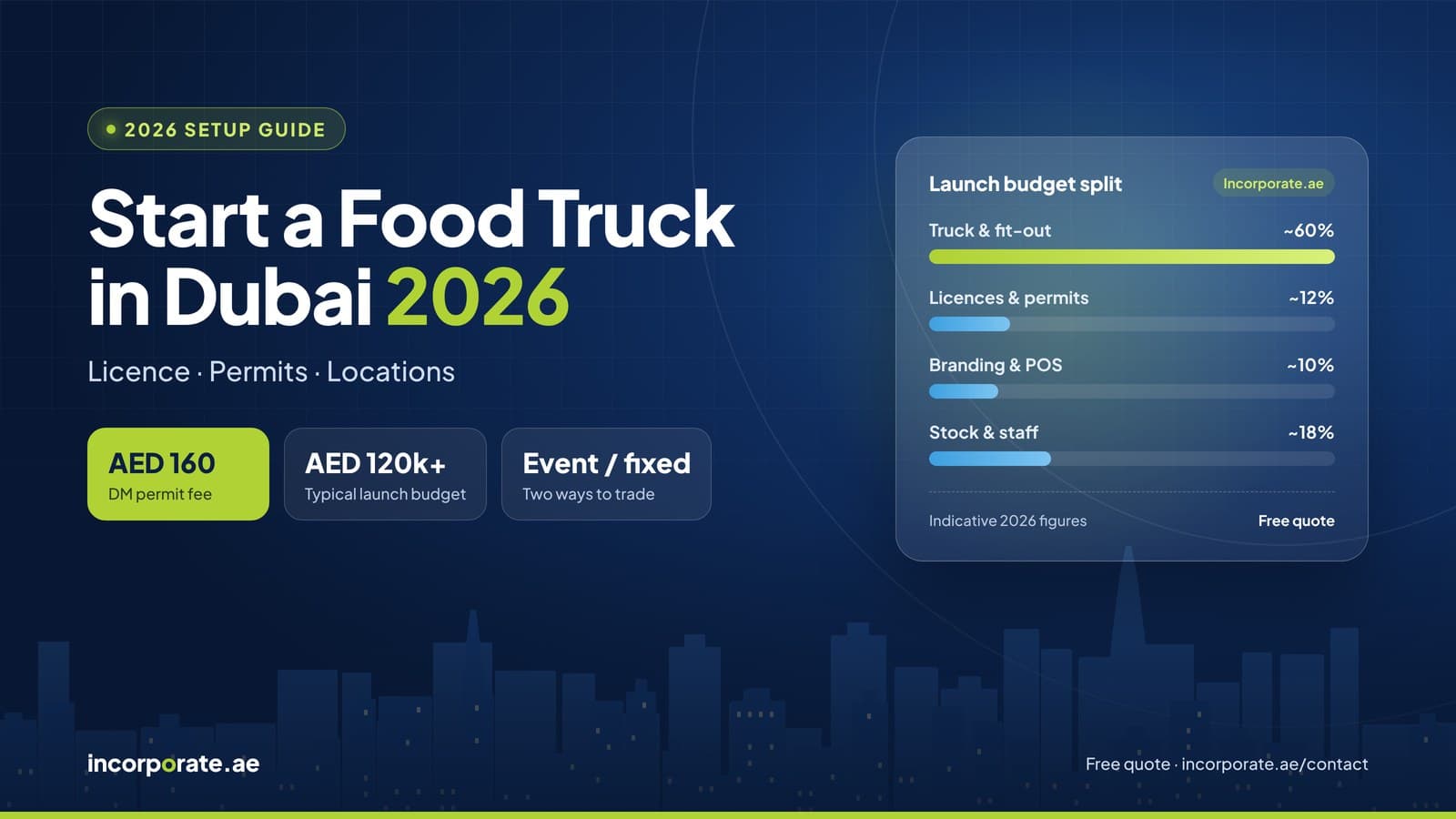
- The Dubai Municipality permit fee itself is small, about AED 160, but a complete launch with truck, kitchen fit-out and licence often needs AED 120,000 – 300,000.
- Food must come from a licensed food establishment with a good inspection grade, so many trucks link to a licensed kitchen.
Food trucks have become part of Dubai's food scene, from winter markets and beach events to business parks and community festivals. A truck lets you test a concept with less money than a restaurant, follow the crowds and build a brand before opening a permanent outlet. But food trucks in Dubai are closely regulated: you cannot simply park and start selling. This guide explains how to start a food truck business in Dubai in 2026: the licences and permits, fixed-site versus event trading, realistic costs and how to turn a truck into a profitable business.
How Food Trucks Work in Dubai
Dubai Municipality regulates food trucks through its FoodWatch food safety platform. There are two main ways to trade:
| Model | How it works | Permit |
|---|---|---|
| Fixed-site (non-mobile) truck | The truck stays at one approved location, such as a park, business district or private site, for a long period | Annual permit linked to a space contract with the site owner |
| Event truck | The truck trades at approved events, markets and festivals | Event permit for each event, applied for in advance |
In both cases the truck must be registered on FoodWatch, and the food it sells must be prepared, stored and transported safely under the Dubai Food Code.
Licences and Permits You Need
| Requirement | Issued by | Notes |
|---|---|---|
| Trade licence for a food activity | Department of Economy and Tourism (DET) | A new company, or a branch licence if you already run a food business |
| Registration on FoodWatch | Dubai Municipality | The truck and any supplying kitchen are registered |
| Food truck permit | Dubai Municipality (Smart Permit system) | About AED 160; typically processed in around one day |
| Space contract and landlord NOC | Site owner | Required for fixed-site trucks |
| Event permit | Event organiser and authorities | Needed for each event; apply at least three working days before |
| Planning and drainage approvals | Dubai Municipality | Layout assessment for fixed-site set-ups where required |
| Vehicle registration and insurance | RTA and insurer | The truck must be properly registered and insured |
Only licensed food establishments with a food inspection grade of A, B or C and no critical or major violations can supply or manage a food truck. If you already run a restaurant or cloud kitchen with a good grade, adding a truck as a branch is often the fastest route.
If you are starting from scratch, many founders pair the truck with a licensed central kitchen, either their own or a shared facility. Our guides on starting a cloud kitchen and starting a restaurant explain how those kitchens are licensed.
How Much Does a Food Truck Cost in Dubai?
| Cost item | Typical range (AED) |
|---|---|
| Truck or trailer (new or used) | 50,000 – 180,000 |
| Kitchen fit-out on the truck | 30,000 – 120,000 |
| Trade licence and setup | 12,000 – 25,000 |
| Dubai Municipality permit and registrations | From ~160 per permit, plus approvals |
| Branding, wrap and menu boards | 8,000 – 25,000 |
| POS, generator and equipment extras | 5,000 – 20,000 |
| Event or site fees | Varies: per event, revenue share or monthly |
| Staff visas and insurance (per person) | 3,500 – 8,000 |
Indicative 2026 ranges. A used truck and simple menu keep costs at the lower end.
Choosing Your Truck
The truck is your kitchen, shop front and billboard. When choosing one, think about:
- Food safety design: stainless steel surfaces, hand-wash sink, fresh and waste water tanks, and proper refrigeration.
- Power and ventilation: a reliable generator or power connection and extraction suited to your cooking method.
- Size and access: event sites and parks may limit vehicle size.
- Truck or trailer: trailers are cheaper but need a towing vehicle; self-driven trucks are easier to move between events.
- Climate: Dubai's summer heat demands good insulation and air conditioning for staff and stock.
Where Can Food Trucks Trade?
You cannot trade anywhere you like. Approved options include:
- Events and markets: winter markets, festivals, sports events and community gatherings.
- Private sites: business parks, universities, construction sites and residential communities with the owner's agreement.
- Designated public locations: some parks and beaches allow trucks through approved operators or tenders.
The cooler months from October to April are peak season. Plan how you will earn in summer, for example through private events, catering or a fixed indoor site.
Build relationships with event organisers early. Good organisers fill their line-ups months in advance, and a strong portfolio of photos, menu and reviews helps you get selected.
Step-by-Step: Launching Your Food Truck
- 1Define your concept and menuWeeks 1 – 2
Choose a short menu that can be cooked quickly in a small space, with strong branding.
- 2Set up the company or branch licenceWeeks 2 – 4
Get a DET trade licence for your food activity, or add a branch to your existing food business.
- 3Buy or build the truckWeeks 3 – 10
Fit out the kitchen to Dubai Food Code standards, with refrigeration, water and ventilation.
- 4Arrange a licensed supply kitchenWeeks 4 – 8
Use your own kitchen or a licensed partner kitchen with a good inspection grade.
- 5Register on FoodWatch and get permitsWeeks 8 – 10
Register the truck, then apply for a fixed-site permit or event permits.
- 6Hire, train and launchWeeks 9 – 12
Process visas, complete food handler training and start with a well-promoted event.
Making a Food Truck Profitable
Food trucks win on speed and simplicity. Keep the menu short, prepare as much as possible in your licensed kitchen, and design dishes that can be served in under three minutes during busy periods. Track sales per event, food cost and staff hours, and drop events that do not cover their fees. Many successful operators earn extra revenue from private events, corporate catering and weddings, which pay a fixed fee regardless of footfall.
Revenue ideas
- Public events and markets
- Corporate lunches in business parks
- Private parties and weddings
- Brand activations and product launches
- Delivery from your central kitchen
Costs to control
- Event fees and revenue shares
- Fuel and generator running costs
- Food waste on slow days
- Staff hours during quiet periods
- Truck maintenance in the heat
Tax and Compliance
Register for VAT once taxable sales pass AED 375,000 a year and display VAT-inclusive prices. Every company must register for corporate tax; see our corporate tax guide. Keep daily sales records for each event, as event organisers and authorities may ask for them, and our accounting team can manage your books.
Trading without a valid permit, or at a location your permit does not cover, can lead to fines and the confiscation of goods. Always check the permit conditions for each site and event.
Worked Example: A Coffee and Waffle Trailer
Nadia wants to sell specialty coffee and waffles at winter markets and weekend events. She already runs a small cafe with a grade A inspection record, so she adds a branch licence for a mobile food unit instead of forming a new company. She buys a used trailer for AED 65,000 and spends AED 45,000 on fit-out, including an espresso machine, refrigeration and water tanks. Branding and the wrap cost AED 12,000. The waffle batter and pastries are prepared in her cafe kitchen and transported in temperature-controlled boxes. She registers the trailer on FoodWatch, applies for event permits through the organisers, and books twelve events between November and March. In summer she rents the trailer out for private parties and corporate events, which keeps it earning all year.
Common Mistakes to Avoid
- Buying a truck before checking it can meet Dubai Food Code requirements.
- Planning to trade on public roads without an approved site or event.
- Having no licensed kitchen to prepare or store food.
- A menu that is too long to serve quickly.
- Ignoring summer, when outdoor events slow down.
Food Safety on the Move
A food truck faces the same food safety standards as a restaurant, with extra challenges from heat, limited space and transport. Keep cold food at 5°C or below and hot food at 60°C or above, log temperatures through the day, and carry enough clean water for hand washing and cleaning. Transport food from your central kitchen in insulated, temperature-controlled containers and record when each batch leaves and arrives. Inspectors at events can check your permit, food handler certificates and temperature logs at any time, and a poor inspection can stop you trading at future events.
Simple systems help: a pre-shift checklist, labelled containers with preparation dates, and one trained person in charge on every shift.
A Seasonal Calendar for Dubai Food Trucks
Dubai's outdoor season shapes a food truck's year. From October to December, winter markets, community festivals and National Day events open up, and demand rises quickly. January to March is peak season, with the best weather, sports events and school holidays. During Ramadan, evening and night markets can be very busy, while daytime trade slows; check event rules and hours carefully. From May to September, outdoor events become rare because of the heat, so successful operators shift to indoor venues, corporate catering, private parties and delivery from their central kitchen. Plan your cash flow so the strong months carry you through the quieter summer.
Frequently Asked Questions
Do I need a licence to run a food truck in Dubai?
Yes. You need a DET trade licence for a food activity, registration on Dubai Municipality's FoodWatch platform and a food truck permit for a fixed site or for each event.
How much is a food truck permit in Dubai?
The Dubai Municipality food truck permit fee is about AED 160, and it is typically processed in around one day once requirements are met. The total cost of starting a truck is much higher.
How much does it cost to start a food truck in Dubai?
Most founders spend about AED 120,000 to 300,000 including the truck, kitchen fit-out, licence, branding and launch stock.
Can I park my food truck anywhere in Dubai?
No. Trucks can trade only at approved sites with a space contract, or at permitted events. Selling at unapproved locations can lead to fines.
Do I need a kitchen as well as a truck?
The food must come from a licensed food establishment with a good inspection grade. Many trucks use their own licensed kitchen or a partner kitchen to prepare and store food.
Can a foreigner own a food truck business in Dubai?
Yes. Food businesses on the Dubai mainland can be 100% foreign-owned.
How long does the permit last?
For a fixed site, the permit follows your site contract, up to a maximum of one year. For events, the permit covers the event period.
Is a food truck cheaper than a restaurant?
Usually yes. A truck avoids high rent and large fit-out, but you pay event fees and need a licensed kitchen, so compare total costs carefully.
Get your food truck on the road
We handle your licence, permits, visas and accounting with one clear quote.
Fees are indicative for 2026 and based on published authority price lists and typical government charges at the time of writing. They change, so confirm current figures with the authority or our team before you apply.
Written by
Incorporate.ae advisory team
Company formation consultants in Dubai who have helped 1,500+ businesses set up across the UAE’s free zones and mainland.